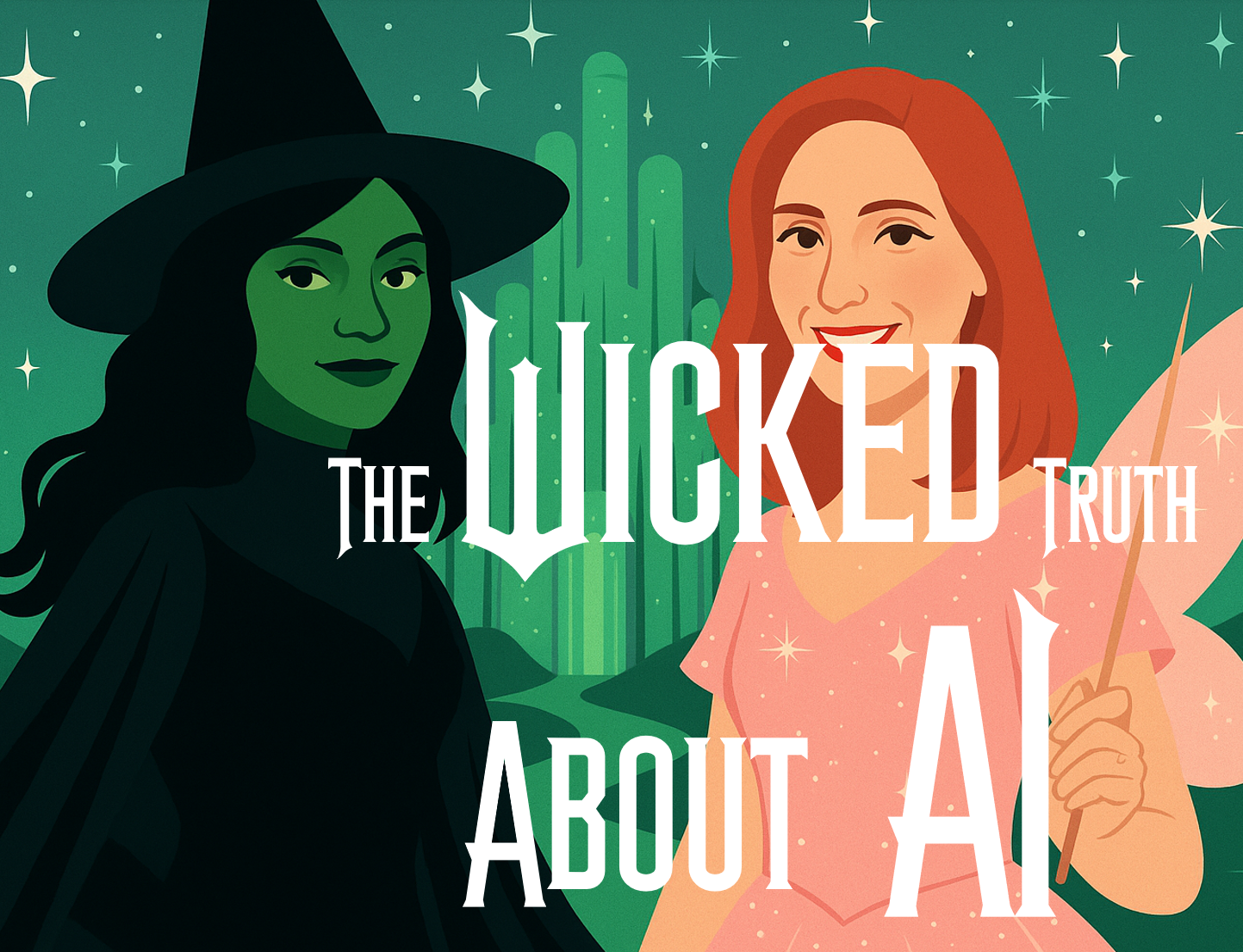
The Wicked Truth About AI
Artificial intelligence is having its Wicked moment – dramatic, polarising, and impossible to ignore. Depending on who you ask, AI is either the greatest technological breakthrough of our lifetime or the beginning of the end. And if you ask the millennials I spent time talking to recently, none of them described AI as purely a force for good. Not one.
Most said it was “a bit of both”. One said it was “a force for evil”. And who can blame them? Big tech, big unknowns, job displacement anxiety – it’s a cocktail of uncertainty.
But here’s the truth: AI isn’t good or evil. AI is power. And power depends on how we choose to use it.
Like Wicked, the story is complicated, nuanced, and full of perspectives that can coexist without cancelling each other out.
The Fear Is Real – And Understandable
When a generation raised on climate crisis, political instability, job insecurity, and algorithmic influence tells you AI feels threatening, you listen. The fear isn’t irrational. It’s logical.
AI will change jobs. It will change industries. It will change the speed and cost of doing business. It will widen gaps between companies that invest and companies that delay. And yes, it will challenge the identity and security of millions of workers.
But that’s only half the story.
AI Is a Force for Good – If We Choose to Make It One
AI can increase access to education, healthcare, safety, opportunity and meaningful innovation. It can remove friction, accelerate outcomes and open entirely new categories of work. It can empower people who have been left behind by traditional education or traditional career paths.
But that doesn’t happen automatically.
It happens through leadership, intention and ethics.
We cannot – and will not – put the genie back in the bottle. AI is here. The only question is: which side of AI history do you want to be on?
People: Learn AI or Get Left Behind
We are all now technology leaders. Everyone. Whether we like it or not.
Your smartphone has more power than the machines that sent rockets into space. And most people barely use 10% of what they already have in their pocket.
If you aren’t learning AI, someone else is – and that someone becomes the person who takes the job, gets the promotion, or builds the thing you didn’t.
Free AI learning resources:
-
Google AI Essentials: https://grow.google/ai-essentials/
-
Microsoft AI Learning Hub: https://learn.microsoft.com/en-us/training/browse/?expanded=azureai
-
OpenAI Learning Resources: https://platform.openai.com/docs
Three next steps for individuals:
-
Learn one AI tool deeply and use it daily.
-
Build a simple project that improves your work.
-
Track what AI can’t do yet – that’s where your value grows.
Businesses: Stop Panicking About AI and Start Planning With It
AI is not a threat to your business. AI is a threat to businesses without a strategy.
A coherent technology, data, and AI strategy will:
-
increase revenue
-
drive margin
-
reduce operational and cyber risk
This is not about replacing people. It’s about removing grind, reducing complexity, and making work better.
Three next steps for businesses:
-
Build a technology and data strategy with clear business outcomes.
-
Train every team – every function – on how AI changes their world.
-
Audit processes and identify which work is low-value, repetitive, or error-prone.
AI uplifts humans. It doesn’t erase them.
Like Wicked – It’s Complicated
AI isn’t the villain. AI isn’t the hero. It’s the story in between – shaped by choices, leadership and intention.
You can choose fear or capability. You can choose delay or investment. You can choose passive adoption or active leadership.
But make no mistake: AI will define the next decade.
The only question is whether you want your organisation – and your career – on the right side of that history.
So learn it. Use it. Shape it.
And like Wicked teaches us: the world isn’t divided into good or evil – just people (and businesses) who choose differently.